



Automatica 2025 confirmed a clear trend: the Digital Twin is no longer a future promise but a concrete lever to revolutionize industrial automation. In the corridors of the leading European fair for robotics and automation, this technology was widely discussed, but what truly made a difference was seeing it applied with tangible results.
At Bonetto Automation, we demonstrated it in the field, showing how the Digital Twin—together with Virtual Commissioning—is changing the way we design, test, and commission complex assembly lines. This transformation starts from virtual design and reaches up to real start-up, with measurable benefits for our customers.
What we mean by Digital Twin
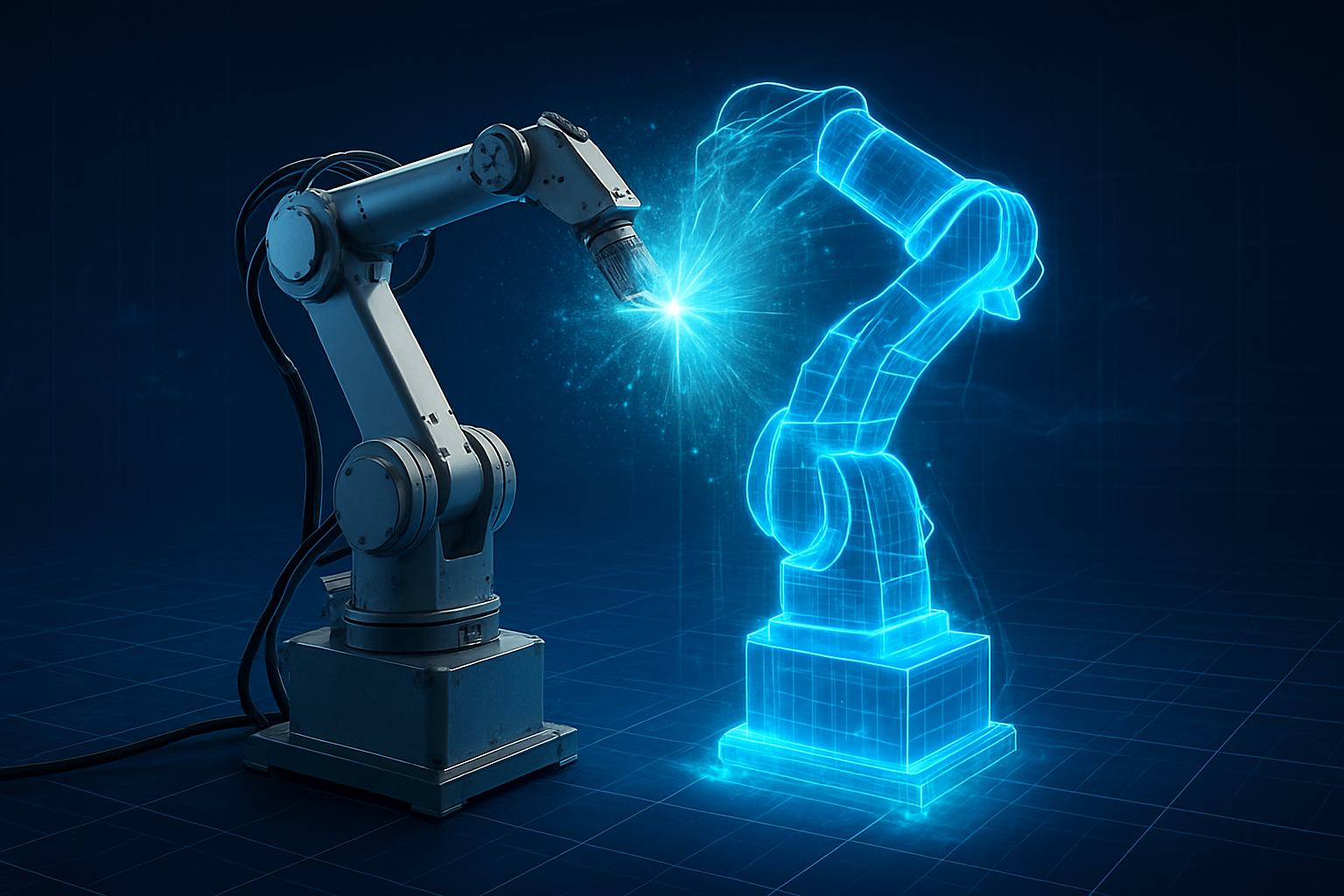
A Digital Twin is a dynamic and interactive virtual model that faithfully replicates the behavior of a physical system: this can be a single machine, a robotic cell, or even an entire production line. Unlike a simple CAD model, which is static and often limited to geometric representation, the digital twin integrates functional, kinematic, and logical information and is directly synchronized with the control system (typically a PLC).
This allows real-time simulation of system behavior, reproducing movements, sensors, actuators, logical events, interlocks, error scenarios, and all typical operational dynamics of a real plant. It is possible to validate both the operational sequence and the automation software, identifying potential critical issues, bottlenecks, or conflicts between axes and moving parts in advance.
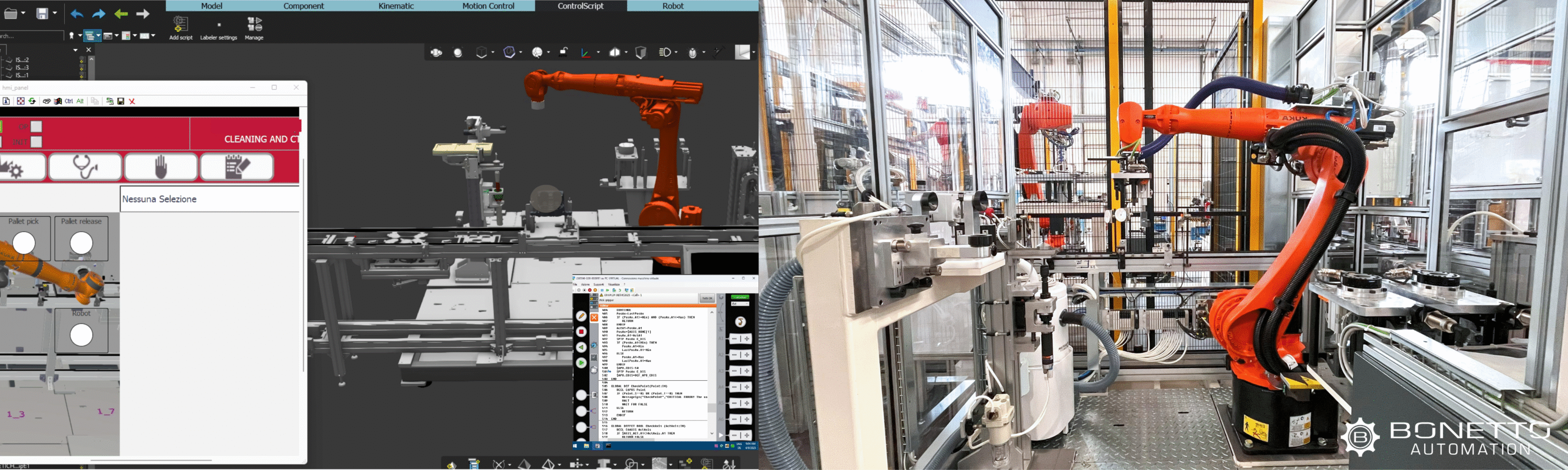
At Bonetto Automation, the Digital Twin has become an integral part of the development process: it is not only a design support but a complete closed-loop simulation environment where the real PLC code can be executed and tested as if it were connected to a physical machine. This approach allows the mechanical and control logic to be developed in parallel, drastically reducing field debugging times.
Moreover, the model can be updated throughout the plant’s lifecycle—from initial concept to predictive maintenance, including operator training and post-startup analysis. The digital twin thus becomes a living asset, able to evolve alongside the real machine and support the entire lifecycle of the automated system.
Virtual Commissioning: testing before testing
Virtual Commissioning is the natural extension of the Digital Twin and allows testing a machine or line virtually even before its physical construction. The digital twin is connected to the real or simulated PLC software, enabling a full test of the machine logic in a safe and controlled environment.
Thanks to this approach:
- PLC code is developed and tested in a closed loop;
- inputs, outputs, alarms, and anomaly scenarios are simulated;
- what-if analyses are run to evaluate faults, conflicts, or slowdowns;
- sequences, interlocks, and safety logics are validated, anticipating possible issues;
- commissioning times and risks are significantly reduced.
Virtual Commissioning also allows more effective collaboration between technical departments, improving integration between software, electrical, and mechanical teams from the early project stages.
How the process works
1. 3D Model Import:The process begins by importing the plant’s 3D CAD models into leading industrial simulation software such as Visual Components, ISG Virtuos, Codesys Simulation, Siemens SIMIT, or Factory I/O. Kinematics are assigned, models are optimized by removing unnecessary geometry, and mechanical constraints are defined to ensure consistency and simulation performance.
 2. Dynamic modeling: Each moving component is configured with realistic parameters such as acceleration, speed, response times, and motion laws. Robots are integrated using specific libraries that faithfully reproduce trajectories, cycle times, and I/O management. Simulated robots include brands like KUKA, ABB, FANUC, YASKAWA, Stäubli, Universal Robots, etc.
3. PLC Programming and testing: The Digital Twin is connected to the PLC software (e.g., Siemens TIA Portal, Beckhoff TwinCAT, B&R Automation Studio, Rockwell Studio 5000, Codesys) through protocols such as OPC UA or Modbus TCP, enabling closed-loop development and testing. Sequence logics, alarms, digital and analog signals, error scenarios, and conflicts are verified.
4. Validation and sharing: After testing, the digital twin can be shared with the customer for demos, training, or functional approvals. Once validated, the control software is ready for installation on the real plant, significantly reducing startup times and risks.
Benefits for Bonetto and our customers
✅ Up to 90% of the code validated before commissioning;
✅ Significant reduction of startup times;
✅ Higher software and solutions quality;
✅ No risk for people or plants during testing;
✅ Ability to iterate and optimize before actual production.
In other words, the machine “lives” before it is even built.
📺 Want to see this in action?
Watch the new episode of the Bonetto Tech Tips series, entirely dedicated to Digital Twin and Virtual Commissioning:
📩 Contact us at sales@bonettoautomazioni.com to discover how our solutions can bring concrete innovation to your company.
👉 And don’t forget to follow us on LinkedIn to stay updated on Bonetto Automation’s latest news, innovations, and expertise.
Digital Twin, Virtual Commissioning, Industrial Automation, PLC testing, closed-loop simulation, automation engineering, predictive maintenance, robotic cell simulation, factory simulation software, automation lifecycle, industrial plant commissioning, control logic validation, machine design optimization, Bonetto Automation, automation software development, 3D simulation for industry, Siemens TIA Portal, Beckhoff TwinCAT, Factory I/O, Visual Components, ISG Virtuos, automation innovation, digital manufacturing, smart factory, virtual testing of machines.