



Planning an Automation Project?
Industrial automation is a strategic lever for competitiveness and growth. Yet, not all projects achieve their expected results.
The issue is rarely the technology; it is the foundational approach. According to the Project Management Institute (PMI) Pulse of the Profession report, approximately 37% of project failures are linked to poorly defined requirements. In the automation sector, this translates to designing lines without a deep understanding of the underlying process or performance objectives.

Defining Performance Before Designing the Line
Automating an unstable flow does not fix it. It simply makes it faster. If variability, bottlenecks and critical parameters are not fully understood, an automated line may amplify existing inefficiencies.
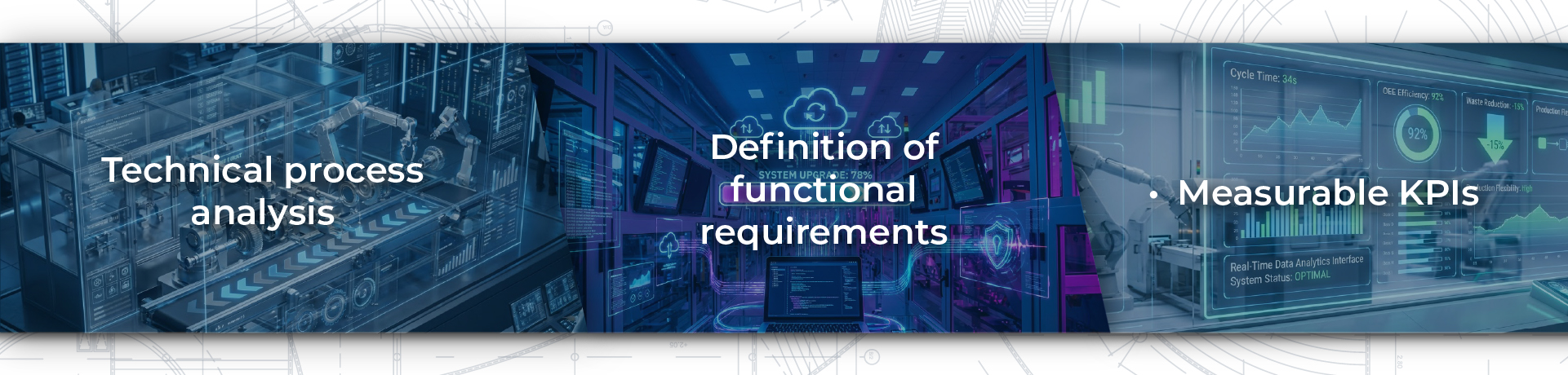
For this reason, every automation project should begin with
• Technical process analysis
• Clear definition of functional requirements
• Measurable KPIs such as cycle time, OEE, waste reduction and flexibility
The Deloitte Smart Factory Study shows that well structured smart manufacturing initiatives can drive productivity improvements of up to 10 to 12 percent and meaningful cost reductions. However, these results are achieved when performance targets and system architecture are clearly defined before implementation.
In a market that evolves rapidly, with changing volumes, increasing product customization and growing performance expectations, aligning the right KPIs is not always straightforward.
This is precisely why a structured engineering approach becomes essential.
Architecture, Simulation, and Lifecycle Evolution
Another common pitfall is treating automation as a hardware purchase rather than system engineering. A modern line must be fully integrated, featuring MES/ERP communication, recipe management, multi-brand integration capabilities, and future scalability.
Furthermore, simulation and validation are not overhead costs—they are essential risk-reduction tools. Digital twins, collision detection, and logic validation allow engineers to anticipate issues that would otherwise lead to delays and cost overruns on the factory floor.
Finally, a plant’s lifecycle does not end with commissioning. Data traceability, software updates, logic optimization, and the integration of new stations are what allow a line to maintain its value over time. Automation is not a “one-shot” investment; it is a production infrastructure that must evolve alongside the business.

The Bonetto Approach
At Bonetto, automation is a structured engineering journey.
Every project begins with a feasibility study, encompassing process analysis, layout, volumes, and performance goals. 2D/3D design and continuous technical consultation ensure that every choice is validated before construction begins.
Assembly and functional pre-testing take place within our facilities to minimize risks during the installation phase. Commissioning includes comprehensive technical training to ensure full operational autonomy.
Bonetto lines are engineered to evolve through:
- Traceability and data analytics
- Software updates
- Continuous optimization
- Future integration of new stations
Because an automated line shouldn’t just start correctly, it must maintain performance, quality, and flexibility for years to come.


Do you have a project to develop?
Contact us
sales@bonettoautomazioni.com